Friday, October 2, 2015

Director's Report, October 2015: Fundraisers, Finances, and the Future

A report from the director
Fundraisers, Finances, and the Future

The Amazon Pueblo project is the intermediary between the organizations and agencies that have  many resources and the people of La Libertad.  We use the money we raise to help provide services with a greater impact.  We harness the enthusiasm of our volunteers and the villagers to achieve our goals.  The village will attain profitable, sustainable business if we keep working towards that future.

In this upcoming year we will be helping to develop the village’s infrastructure.  This is needed as we start the first indigenous-run business ventures.  As we prove ourselves with successful completion of the smaller projects, the possibilities of large-scale, highly profitable and sustainable cacao production will become possible.

The public dock (funded by Amazon Pueblo)


Goals

These are the goals for the years of 2015-2016.
  1. Increase the number of volunteers assisting the project
  2. Directly develop sustainable business in the village
  3. Make connections and partner with other NGOs or businesses that may assist the village to develop sustainable business, directly or indirectly by assisting with business, health, or educational services
  4. Improve the health and sanitation conditions within the village
House construction

Fundraisers and Finance

A warm thank you to everyone who helped to plan, run, fund, and clean up after all of the fundraisers!

In California we made $2,363 from donations and $120 in profits from handcraft sales.
In Maine we made $706 from the silent auctions, $725.15 profits from handcraft and emerald sales, and $1,817.98 from donations.

Other donations and income for January 1, 2015 until September, 21 2015 is $156.

Our total income (profit) from fundraising, sales, and other income was: $5,888.13. The cost of the goods (handcrafts and emeralds) that we sold was $477. After all of our expenses (fees, cost of goods sold, promotion, travel, software, and subscription services) we currently have $5,447.47 in our checking account, and $100.45 cash in hand.

I expect us to have another $80 in expenses (QuickBooks program cost, Facebook fees, postage stamps) in September/October.

Piranha Party Fundraiser at Trackside Restaurant, Rockland, Maine


The Future

Buying more handcrafts and emeralds
The cost to us from what we sold was $477.  I think it best to buy $477 of handcrafts and emeralds to replace what we sold.

Our recommendations are to buy more bloodwood jewelry, bloodwood carvings, bloodwood key chains, beetle wing earrings, 3 piranha, and 3 blowguns ($177 total).  I will buy these in the village.

As for emeralds we think it best to buy silver rings, stud earrings, and simple drop earrings.  We should keep our selling price for emerald jewelry between $45 and $150.  The total cost of the emeralds will be $300.  I will buy these in Bogota.

Handcrafts from the village


Travel

Trip to Portland, Maine
A company in Portland, Ocean Renewable Power Corporation ORPC, is developing a floating hydroelectric power system.  They could possibly provide reliable, 24 hour electricity for La Libertad and the adjoining village.  The cost is expected to be less than the current diesel generator system.  They are interested in speaking with us.  It is possible that we may be considered for a pilot project.  I expect the funding to come from an Amazon Pueblo-brokered ORPC, other NGO, and government grants.  I am meeting with them on October 8 at 11 am in Portland.

RivGen® Power System by Ocean Renewable Power Corporation, Portland, Maine


Trip to Washington DC
I have been in contact with a friend of the project who works for the US State Department.  He is encouraging me to make connections in Washington and the US embassy in Bogota.  He believes USAID would be interested in helping us.


We are also meeting with a consultant from the Chisholm Group.  The group works with NGOs, governments, or anyone else who needs help with the Washington bureaucracy.  They have an office in Washington and Colombia.

The second reason for this trip is to meet with representatives from Sustainable Harvest International (SHI).  They are based in Ellsworth, Maine.  However, for this meeting I need to go to DC.  I met with SHI last October to learn about their organization and to tell them about us.  They mentioned that there were possibilities of us working together, possibly seeking a combined grant to help with sustainable agriculture in the village.  We were not ready to go forward with this partnership last year.  Now we are ready.  The meeting will be between the Field Program director, Program Impact Officer, two Country Directors, and myself. 


The cost of this trip will be $380 for a plane ticket, bus ticket, and car rental.
I believe this trip to DC will help to put us on the path to secure the funding we need for the major works of the project.


Upcoming Expenses in Colombia
Here is what I expect for expenses in Colombia:
  • Repair rot to the kitchen and dock; $300
  • Fees for Fundacion Amazon Pueblo, Association of Farmers, and support; $100 (due in January)
  • Internet; $30/month
  • Local travel costs in gasoline/oil/dock fees; $40/month
  • Boats, motor, and hull maintenance $200
  • Rent?  It is $200/month which I am paying for until we have more income
  • Building a semi-secure storage area in the guest house and building maintenance costs; $300
Project volunteers doing an arts and crafts activity

Possibilities of income

We are applying for grants.  One of our project volunteers in the village, Jeff Sires, said he may be able to help us find and apply for grants.  He has experience in the field.  We may also receive donation money from Destination Compensation.  All grant and donation money would be targeted for a specific program.  Up to 15% of the money from the grant may be used for rent and administrative costs.

Painting the world


Grant Projects

Here are the projects for which we need grant funding.  This list is in order of importance and ease of attainability, more or less.
  • maintaining and finishing the village's raft (We have received approval for a grant from the Colombian government, so hopefully we have this covered.)
  • volunteer support (fix the rot in the kitchen, improve the guesthouse, improve telecommunications/internet, plant and tend a vegetable garden)
  • drilling a well and putting in plumbing and 25 bathrooms in the village (I am applying for our first grant with the Coca Cola Foundation to cover this.  I have also recently received communication with the governor's office in Leticia.  They said that they may be able to help with funding.)
  • buying an aluminum boat and a 30 hp outboard motor
  • aquaculture (Colombian grant money may be available to start this.)
  • starting a pilot project for growing cacao, at least 5 hectares (100 meters X 100 meters) to start  (This is the most expensive and complicated project on our list.  I believe this also holds the most hope for sustainable business.  The grants for this may come from a variety of sources.)
  • Improving agriculture in the village
  • Small business development

Climbing a tree for fruit

Grants Sources

Here are two of the sources that I am using to find grants.  There are also many more.  Anyone may help in our quest for grants.

If any of our project readers are interested in helping us to search and apply for grants, please contact us!  benangulo@amazonpueblo.org.
Grant Station is a database of many grants.  They also offer information about applying for grants.
I like this better than Grant Station for finding grants.  They have a great newsletter to which you may subscribe.  They offer a free service.  Next year we may not renew our Grant Station subscription and instead go with this company's premium service.

Village meeting


More Money Needed
The money we have now, I expect, will keep us operating in Colombia until January.  We need at least $1000 more to take us until June.  Anything above that is better.

I worry about Gustavo’s motor.  Gustavo is our main supporter in the village.  His motor is difficult to start, sometimes stops, and needs repairs.  He helps provide us with transportation.  At the least we can help repair the motor.  However, it may be time to start thinking about getting our own motor for the project’s boat.

Gustavo's motor.  It is in need of much repair.

Continued Fundraising
We are currently having a raffle for a lobster trap rocking chair (Thanks Mark, Julie, and Stephen!).  We also are slowly receiving small individual cash donations.  We may give a second try at raising money through a social media campaign.  We didn’t have much luck last time, but we can try again!

Night meal

One of the most important health and safety concerns in the village is the lack of life vests for boat travel on the river.  We recently had a child drown due to bad river conditions.  A campaign to buy, maintain, educate, and disperse (in a borrowing-type program) life vest may be a good way to restart our crowdfunding efforts.

That's it for this report.  Thanks for reading!
(Photo credits to Beki Henderson and Crystal Angulo)

The Amazon River

Thursday, September 17, 2015

Piranha Party program of activities

Here is the program for our 2015 annual fundraiser.  We hope to see everyone at Trackside Station Restaurant (4 Union Street) in Rockland, Maine, Friday, September 18 from 5 until 9 pm!


Saturday, August 29, 2015

Healthcare in the Village: Piranha attack, insect bites, teeth, parasites, and tragic loss

This is the second post this year about the healthcare in the village.  For the first part, please click here.

Today's blog post is about some of the things that I experienced over the past few months since my first healthcare report.  However, I will not mention Dengue Fever, Malaria, Tuberculosis, STDs, heart disease, cancer, alcoholism, or drug addiction; all of which are experienced by the villagers.  I will save these issues for another day.

Perspective
While reading this report, please do not think that the villagers' lives are filled with constant misery.  The children do not know that they live in poverty, because they have no knowledge of the things we take for granted, such as a shower or a toilet in your home.  The adults have, more or less, accepted the things that they do and do not have.  They long for comfort (as do we all) but are content to live in the jungle and happy to be with their families.  I see more laughter and smiles in the village than I have ever seen when shopping in a store or eating at a restaurant in my comparatively wealthy home country.

Additionally, these reports are among the worst of what I have personally seen during my last eight months of time in the village.  Most families experienced nothing worse that lice over that time.  And the people that have followed the project's advice for cleanliness in the house, good bathroom and hand washing habits, and treatment of infections have a noticed improvement in their health.  Gustavo's family, our neighbor, is an excellent example of this.

Piranha Bite

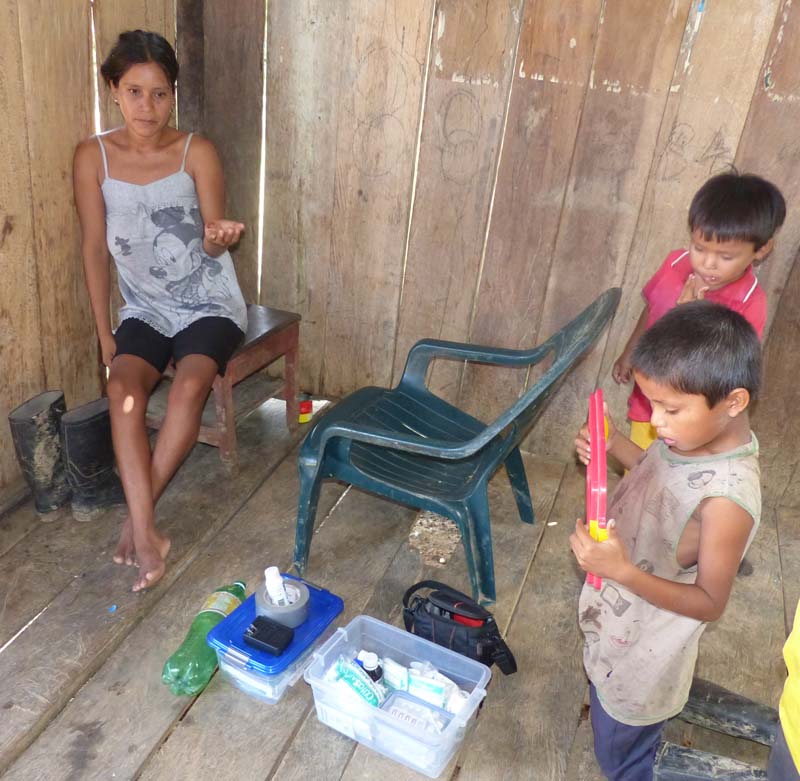
Patricia and her two sons with our medical supplies
It was a hot afternoon.  Two of the village children burst into the kitchen while I was painting the wall a vibrant green.  They said that Patricia had been bitten by a piranha and was bleeding badly from her hand.  I ran up to the guesthouse and grabbed our medical supplies, then walked quickly to her neighboring house.


She had been cleaning the fish her husband had just caught.  One was a large black piranha.  It was not yet dead.  When she started to gut it, the piranha spun around and sank its teeth into her hand.  Patricia, thinking quickly, placed her hand against the side of the boat, while her husband quickly wielded a small club and hit the fish on the head. I learned to NEVER pull on a piranha that has attached itself to the skin.  The result would cause the flesh to be sheared off and removed with the fish.


The bite
After getting the fish off her hand the wound bled profusely.  However, this was better than only a little bleeding, as the generous blood flow helped to clean the wound.

When the bleeding stopped I cleaned the wound further with an iodine solution and dressed it.  I also gave her some antibiotics to take.  I checked back with her on the following days.  Her hand was healing well.

Infected Bug Bites (sometimes with worms as an added bonus)

The two mystery bites after the first round of draining
I woke up one morning and found that two of my bug bites, of which I had at least 20, were a bit more swollen usual.  I watched them grow until they were of an alarming size.  I showed them to my neighbors, who said that they may have worms inside, slowly eating my flesh and growing.  I have seen this happening to my friend's two pet dogs, so I knew they must be treated.

Pelacho and Cani the dogs

The dogs had small flies bite them and lay eggs beneath their skin.  The eggs hatched into worms and started to feed on blood and tissue beneath the skin.  As the worms grew they became more noticeable.  If carefully watched the worms could be seen to move slowly underneath the dogs' skin.  A small breathing hole was found in the skin around each worm.  The usual method of treatment is to place gasoline over the hole.  When the worm comes up to breath, it may be grabbed with the fingers.  The worm fights being pulled out, but usually may be removed.  If left in the body the worm will turn into a small fly, then emerge to start the cycle again.

Edison treating the bite with nicotine (an insecticide) from a tobacco cigarette
An alternative is to smoke some tobacco and use the nicotine-containing resin from the cigarette to cover breathing hole.  Nicotine is an insecticide.  This slows down the worm when it comes to the breathing hole, making it much easier to pull out.

Searching for the worm
I opted for the nicotine treatment instead of the gasoline.  After keeping the nicotine on the insect's breathing hole for 10 minutes, my neighbor pierced the swollen bite to try and remove a worm, but none were found.  It was a simple infected bite.  I started a course of antibiotics.  My hand healed well, with only two slight skin discolorations over the bites to indicate anything had ever happened.

I am very happy to be parasite-free

Dental Care
In June, 2015 a dentist from Canada came to the village to do dental exams and judge the needs of the villagers.  About 80% of the villagers had cavities.  Some of the people, both old and young, had extensive dental disease.  Out of the 100 people viewed, at least 10 were evaluated as requiring dental extractions -and in many cases multiple ones.  These dental problems may have come from a combination of sugary and starch foods coupled with poor, or no, flossing and brushing.  We discussed the importance of good oral hygiene and how it can influence health.

Over three-quarters of all villagers have rotted teeth
Eyesight
About 10 people in the village suffer with eye disorders.  Many of these go untreated.  An uncounted number of people over 50 years old need reading glasses.

Gustavo, pictured below, has frequent eye pain.  This is especially bothersome for him when he needs to navigate on the river.  At times, his eyes become bloodshot, dry, and his vision blurry.  He is not sure how long he can keep working if the condition worsens.

Gustavo suffers with eye pain, especially during river travel

This woman has, I believe, a cataract.  If this is correct, then it may be easily treated.  If any eye care professionals are interested in helping, they are greatly needed.

A cataract???
Mystery Infection
The three year old boy pictured below was brought to us during the dental exams.  His upper leg was swollen, tender in the center of the swelling, slightly red, and painful.  It looked like an infection to our dentist, our photographer, and me.  This condition had lasted two weeks.  He had trouble walking and needed to be carried up the hill to our meeting place.  His father said that he was brought to the clinic in the city of Leticia (50 km away) one week earlier, and had only been given a pill, then send away.  It had cost his parents a day of work and two more days of pay to bring him to the clinic.  They wanted to know if we could help.  We offered to help take him back to the clinic and insist that he be given proper care.  We even offered to pay the parent's transportation costs to leave the following morning.

The next morning came and we were ready to take the boy and one of his parents to the clinic.  They did not arrive at the dock at 8 am, as agreed.  There had been a party in the family's neighborhood the night before.  His parents had stayed up very late.  After going to his house and waking the father, he said that his son's leg had improved, and that he no longer needed to go.  I and the two volunteers with me felt very frustrated.  We left La Libertad that day, and then I returned to the United States.  I will investigate what happened to the boy when I go back to La Libertad in six weeks.

Boy with a swollen leg
Intestinal Parasites
No discussion of healthcare in the Amazon would be complete without a discussion of intestinal parasites.  While I have not tested the entire village, I believe 100% of the people have multiple intestinal parasites.  Upon returning home to Maine two years ago I tested positive for five different types.  These included cryptosporidium, blastocystis hominis, giardia, and other two others I cannot remember.  I now have the most sanitary kitchen and the most purified drinking water in the village.

Girl with a swollen (roundworms) belly
The majority of the young children have swollen stomachs due to intestinal parasites.  These parasites include the ones I mentioned before, but they also have Ascaris lumbricoides, the giant roundworm.  This is the most common worm infection in humans in the world.  The worms are between 7 and 15 inches in length.  A female can produce up to 200,000 eggs per day.  The eggs are passed out of the body with the feces. After excretion the eggs may live in the soil for up to two years under the correct conditions.  When the eggs are stepped on, they may attach to the skin and then passed to the hands, and afterwards to the mouth.  They may also spread by contaminated water.  Out of the 26 houses in the village, only two have toilets.  All the other houses practice open defecation; usually within 10 yards of their homes.

With time the people of the village adapt to their parasitic infections.  Only the very young, very old, or the sick are really bothered by them.  It takes years to build up a tolerance.


Orley the boy with Cani the dog (and both with roundworms)
The boy above was given anti-parasite drugs by a state-sponsored healthcare work who gave the medications on a visit through the village.  They visit every two to three months.  Two hours after taking the medications the boy started vomiting worms.  The medication is not always popular with the children.

Our med kit
Tragic Death
I arrived in the village during the mid-afternoon.  We had traveled upriver in the boat belonging to the project, a small but river-worthy, seven meter covered craft.  The trip had been uneventful, but the wind and waves were a bit on the high side.

The Viejo Bravo

While walking down the path to the guesthouse I saw a small crowd of people gathered in front of our neighbor's house.  I greeted Wagner, one of the supports of the project.  He told me that our neighbor's 9 year old son, Fermil, had been lost in the river earlier in the day.

The boy almost always accompanied his father on trips to help and to provide companionship.  Fermil's father had been transporting food and handcrafts from the Colombian side of the river to the Peruvian side.  His boat was small, had low sides, and was overloaded.  They had no life preservers.  The waves broke over the side of the boat, it flooded and capsized.  The undertow currents caught the boy and pulled him under.  His father was unable to find him.

Fermil was one of the nicest kids in the village.  He always came to the shore to help us carry supplies from the boat to our cabin.  He played well with the other children, helped his mother around the house, and was always friendly and willing to talk or lend a hand.  He also came to every English lesson offered by our volunteer Sarah, who said he was one of her best students.  He will be missed.

This story relates to healthcare in the area of preventable death.  With proper forethought, with care during life's activities, tragedies such as this one may be avoided.


Sarah with Fermil and his sisters.  He was one of our best English students.

The Future
We try to help.  We are currently making contacts with other organizations in the Amazon, raising funds, organizing volunteers, and developing our program to provide effective services.

Some of our goals for 2015:
  • raise $6,000 by September 30
  • drill a well and build one bathroom for every two houses
  • start raising funds for a safe boat and motor for project/village use with life preservers
  • make advances in sustainable business, healthcare, and education.  
Our website has more details.

Volunteers
After reading this post my aunt commented, "Why would any person want to volunteer in the village after reading this?".   Visiting the village is not for everyone.  We have had 14 volunteers spend a combined time of 15 months in La Libertad.  The biggest complaint is the bug bites, from which only I have had an infection.  We have had one other volunteer contract intestinal parasites after visiting Colombia.  However she spent one month traveling in other parts of the country (in parts also known for parasites), and only three days in the village.

We have learned over the past three years of time in La Libertad the best ways to store food, disinfect surfaces, treat skin infections, wash clothing, avoid insect bites, and to stay healthy.  We hope to pass along this knowledge to the members of the community for their benefit.

Would you like to help? Please visit How to Help

Thank you to Beki Henderson, Crystal Angulo, and Sarah Blackman whose photos helped to make this post possible. 

Wednesday, August 26, 2015

Our first benefit dinner (pizza) in California

I arrived here on Tuesday, and the weather this week in Southern California has been beautiful.  Not a drop of rain, which is unfortunate, as this continues the multiple-year drought.  I believe they wrote a song about this...

Now on to the fundraiser news!

We had been preparing for the event for the previous months.  My sister Crystal, also a project director, had been organizing and telling people about the event.  We also were required to register the project in California as a charity.  After sending in the applications and fees to the California Attorney General and Secretary of State, we were good to go!

Display for handcrafts and informational flyers
My sisters, father, and Joan all helped to prepare the house for the festivities.  A large flat-screen TV was ready for the slideshow presentation.  The pizza was freshly made from a local restaurant called Pizzamania.  Chairs and tables awaited.  Friends and family started arriving to my family's house in Long Beach a little after 5 pm.  Our total crowd numbered around 40.

Cousins and aunts

After settling in, visiting and having some pizza, salad, and finger-foods, at 6 pm we all gathered in the living room for the presentation.  It lasted about 20 minutes, longer than the planned 10 minutes, but the crowd was attentive, engaged, and eager to ask many questions.  We discussed the early history of the village of La Libertad, why they have many of the problems which they face, and the solutions that we have implemented or for which we are in the planning stages.  Of special interest was the relationship that they have to the illicit drug trade, healthcare concerns (parasites), and cultural differences.  And of course the piranha!

Astor and I giving the presentation
If you would like to see the presentation, I have uploaded it to SlideShare.  Click here to view it!

Small handcrafts made by the villagers were displayed and available to purchase.  People also generously made donations to help support our work.  In all, we raised a little over $1,500, with more pledges on the way.  Thank you to all of our supporters!  And a special thank to Crystal (without whose help this event would not have been possible), Rose, Rudy, and Joan for all their greatly appreciated efforts.


Equally important to the financial support, we made many connection to people and discussed other ways to help the village.  Almost all of our 40 informational brochures were taken.  A few brave souls were even excited about planning a volunteer trip to La Libertad!

If you would like to donate to the cause we have another fundraiser taking place in Rockland, Maine on September 18.  If you can't make this, we accept online donations through our website (please click here to DONATE ONLINE).  Thanks!

We are well on the way to achieve this summer's fundraising goal of $6,000.  Please help us fill in the monkey graph!


Friday, August 21, 2015

Piranha Party Fundraiser!

Join us on Friday, September 18th, at Trackside Restaurant in Rockland, Maine, 5 pm to 9 pm!


Why: The village is one of the poorest in the region. They are surrounded by the beauty of the rainforest jungle, but the villagers have no clean drinking water, poor sanitation, inadequate healthcare, and few sustainable employment opportunities. In the Amazon, 3280 acres of virgin rainforest is being cut every day. We want to help them to develop sustainable businesses, to be self-sufficient and to slow the rainforest destruction. This in turn will help to counter climate change and to preserve the world’s largest oxygen-producing area.

Would you like to donate but cannot make it to the event.  Please click here to go to the donations page of our website.  Thanks!


Wednesday, August 5, 2015

Help us to Sell Handbags for the Amazon

Do you know someone who has a store where we may sell handbags made in the village?  Are you interested in helping us to make a connection?  If so, WE NEED YOU!

rectangular handbags

All Natural Materials
All of the materials used (with the exception of metal for parts of jewelry) are found within and around the village.

round, flattened, very sturdy handbags

The cord used in the handbags is made from separating palm fibers. The fibers are then twisted and joined to form up to 10 meters in length.  Depending on the color natural dyes are add to the cord.  Some of the dyes must be boiled from roots, some made from crushed leaves, and others are made from seed pods.

Any small brown beads used in the handbags are taken from seed pods. The seeds must be strung within one hour after removal from the  pod. After the one hour time the seeds become dry and hard, and very difficult to pierce.

Fish scales and other plant parts may also be used in a bag's construction.

slightly larger cylindrical handbags


The red wood used for in the handcrafts comes from a tree called palo sangre or “bloodwood”.  This is a very hard wood.  I once tried to carve a figure from the wood using my pocket knife.  After one hour of carving I only managed to remove a small corner of wood and almost cut off my finger.  Now I leave the carving to them!

Gustavo and Rosalba make handcrafts to sell to tourists.

The majority of many of the villagers' income is dependent on handcraft sales and tourism.  Depending on the item, it takes from one to three days to make.


How to help
If you would like to help us to help sell the handbags of La Libertad, please contact us at benangulo@amazonpueblo.org.  We are still exploring shipping arrangements and costs.

The prices range from $5 for a small cellphone-sized bag to $15 for a large handbag, plus shipping costs.  Handbag may be custom ordered.  All profits go directly to the people who make the crafts.

Thanks!