After years of fundraising and planning, we have finally started building the center. From April to June of 2022 we bought materials, transported them, and found skilled workers to do the construction. We have completed the first phase. During 2023 we hope to complete the second phase, putting up the walls, doors, and bathroom. We thank everyone who helped us to achieve our goals!
The almost-complete roof on top of the concrete slab and columns. The roof is corrugated, painted metal on a structure of welded metal supports.
These medications are from Peru. While untrained people are not allowed to prescribe and give medications, the health center will give the villagers a clean and an organized place to administer their meds.
This poster was on the wall of one of the health clinics in the city of Leticia. It shows some of the illnesses and accidents common in the river communities.
Once the center is up and running, we hope to help sponsor vaccination clinics. It is easier for the providers to come to the community during a scheduled time.
This boy had a skin infection from coming into contact with the unsanitary ground conditions during a soccer game. An antibiotic cream helped to clear it up quickly.
This picture shows a terrible skin infection. The man lanced a small boil
on his back with an unsterile orange tree spine. Within five days the infection
advanced to the above stage. Just days more without treatment and he may have
died. If he had had access to the center, he could have used a disinfected needle
and he may have avoided the infection.
Luckily, he went to the hospital in the city of Leticia. There he underwent treatment with aggressive antibiotics and two surgeries to remove the infection. He recovered within two weeks, but it will take up to a year for the skin to completely regrow.
Many times the health problems in the village may be treated when they are small before they become more serious. Basic things like small wound treatment and disinfection are all that is needed. The health care center gives them an area to do these simple things.
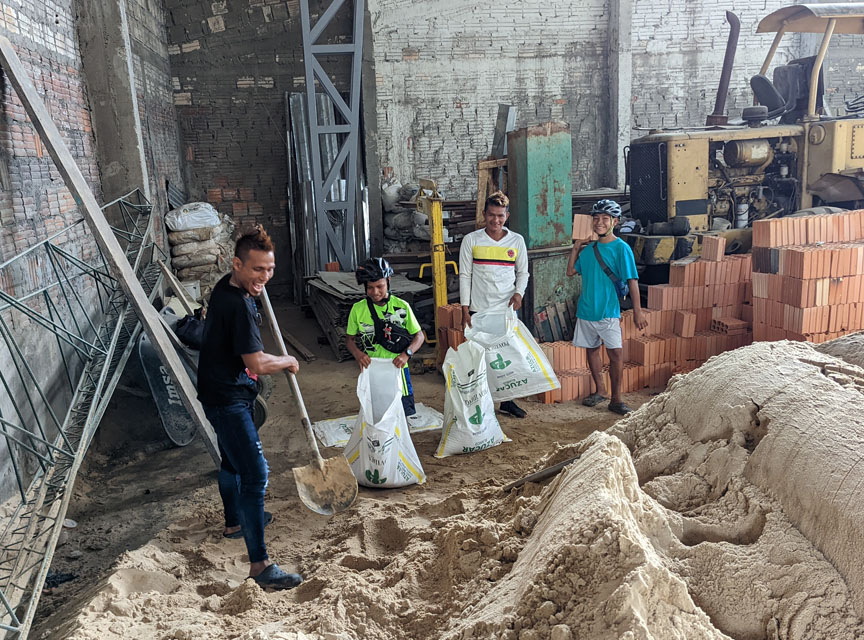
We loaded the gravel into empty feed bags.
Next, we loaded the sand.
And last, the bags of cement. Each bag had to be wrapped in plastic bags to protect against water in the trip upriver.
After being placed in plastic, each cement bag was then placed in a feed bag to make it easier to carry and more resistant to bag rips.
Then we carried the bags at the port of Leticia to our boat which was docked at the Balsa Piranita, a floating raft.
When everything was loaded we could head upriver. Our 35-foot wooden boat can transport no more than 2 and 1/2 tons.
Rebar to reinforce the cement.
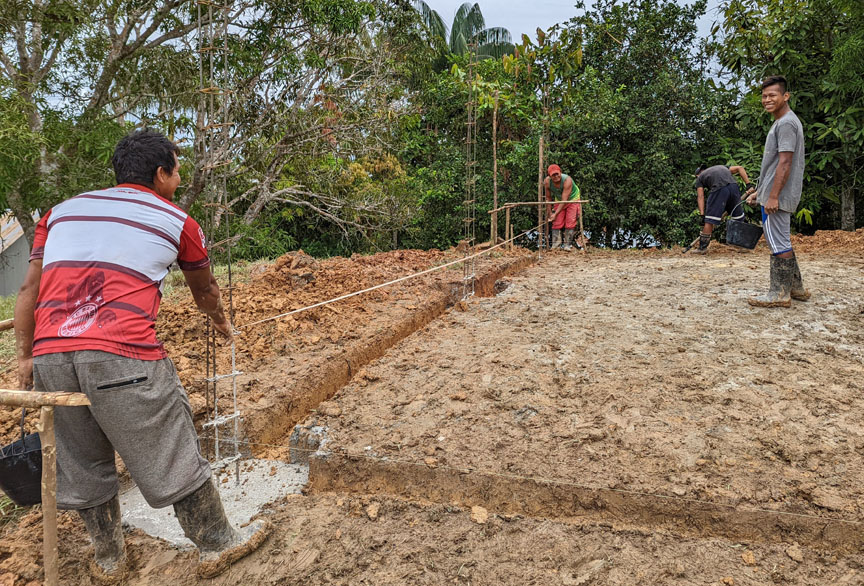
At last, we are preparing for the construction work. These are rebar supports to be used inside the concrete columns.
Preparing the footings for the concrete slab.
Now it is really starting to look like something!
All work must be done by hand. We have no heavy machinery in the village.
Doing the last part of the floor. The floor had to be finished all at once.
The forms for the columns are up.
Now the columns needed a week to dry and harden.
While we were waiting for the concrete to harden we had time to get the roof ready. Originally, we planned to use wooden support for the roof. But we ran into problems. The beams we had cut warped badly. We decided to construct everything with metal. This was a much more expensive option, but one that we believed would give us a much stronger roof and much better longevity.
It took us three trips in our smaller boat to bring up all the metal beams.
The beams had to be sanded, cleaned, and painted with rustproof paint.
After some worrisome delays, the welders arrived. We housed them in the guesthouse, where they stayed for three days. We also provided them with food during this time.
Many of the villagers have never seen a person weld. During the work there was a party-like atmosphere!
In this video, the welders are installing the
roof understructure. Look for the two kids in the tree!
These "tejas" are four meters in length. They come painted. We had to go upriver to Peru to find them. They are much less prone to rust.
The center is in the middle of the village, on a hill next to the school.
In the next phase of this project, we will be building the walls, doors, and bathroom. The cinderblock pictured below will be made in the village. We have sand that we can clean, sift and use. We also have the forms. All that is missing is the cement, water, labor, and bringing everything together!
One of the village kids shows an example of a cinderblock we will use for the buildings.
Through the health center, we will achieve the following five things:
Provide a place for the students and their families to receive basic health care.
Provide a place for medication to be stored.
Provide training to specific members of the community to treat illness and injury.
Provide a secure place for health and community records to be stored.
Provide an office and dormitory for visiting health care providers.
But there is also the option for you, as a volunteer, of joining us physically in the village of La Libertad to help with the construction! Our guesthouse, kitchen, and bathroom are clean and mostly comfortable. Please contact us at info@amazonpueblo.org for more information.
Roof, rot, rats! These pictures show the deplorable state of the school buildings in the village of La Libertad. The community school is in need of one more teacher. No new teachers want to come here, and for good reason.
The village school of La Libertad is located in the Colombian Amazon, South America. It serves 90 children aged 5 to 13. The families of the school children live in extreme poverty. Many of them earn less than two dollars per day, have high illiteracy rates, and have no steady employment. School and education are the best hopes for the village children to have better opportunities for sustainable employment.
The school is in a deplorable state of repair. For many years the buildings have not been properly maintained. The students and parents are not able to advocate for the school and themselves. The teachers fear if they bring up the problems they will be seen as "troublemakers" and face repercussions.
During the pandemic, the problems became worse. The ceilings of the classroom are falling in, boards are rotting, the roofs leak and the teacher housing has holes in the floor with rats running freely.
For the past six months, the school has been short of one teacher. No new teachers want to teach in La Libertad, given the terrible condition of the school and support buildings.
We are raising money to fix the school. We will repair the ceilings in the classrooms, change the roofs, replace the rotten boards in the teacher housing, and paint where needed.
We seek donations to help fund our work in the community. In all, it is estimated that we need a minimum of $2,000 to do the majority of the school repairs. The link for donation is found below.
One of our scholarship students presenting "Stone Soup" during the Mother's Day celebration, in 2022.
We use the company Chuffed to accept donations. Thank you for reading!
Sometimes the journey is more fun than arriving at the destination! We spend a lot of time on the river. Going upstream can take up to twice as long as going downstream. If we are in a large boat with a small motor, the trip can be over four hours. Here are some random pictures of this year's trips.
Our first picture is from a return trip to the village after doing school shopping for the scholarship program. The day was beautiful, with scattered rain showers. We were lucky to have a spectacular rainbow in the background when we stopped for a break about halfway to La Libertad.
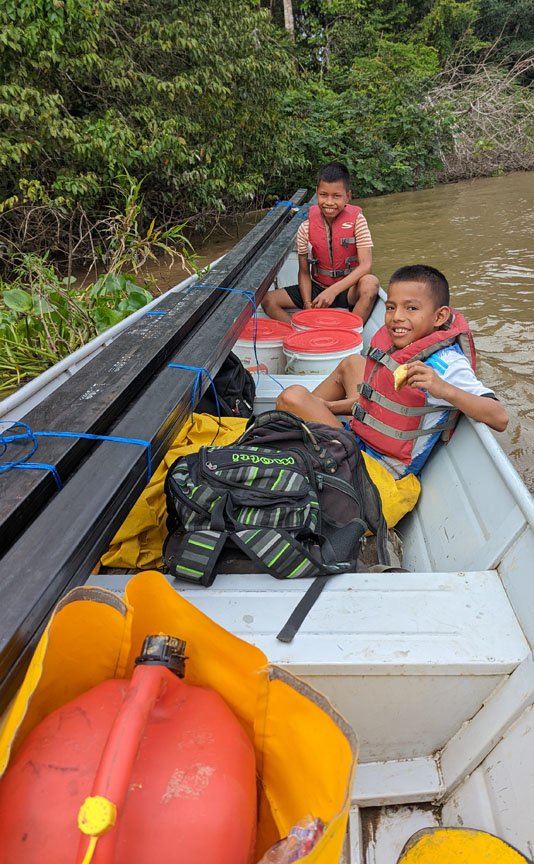
Here we are traveling during the rainy season to bring supplies to the village. The pails in the bow of the boat contain food, hardware, paint, and the like. Anything we don't want to be soaked by the rain we put into huge trash bags. This shot was taken during a gentle rain. Slightly before this was a torrential downpour. The visibility was reduced to about 500 feet, so we had to greatly reduce our speed. At times the rain is so heavy that we must pull to the side of the river and wait until it is safe to continue.
During the rainy season, the water level may increase up to 30 feet from the low of the dry season. This lets us go further in the tributaries, up to a mile into the jungle. Cargo is much easier to transport, allowing us to drop off our supplies close to our back door!
The trip upriver can take between four and five hours with our 35-foot wooden boat and a full load. It's a good time to relax (unless you are driving), talk, listen to music, or play around. However, everyone down to the littlest child knows not to rock the boat!
We always try to leave Leticia, the closest city downriver from La Libertad, no later than 2 pm. We account for weather or mechanical problems, which can increase the travel time greatly. At the back of the boat, with the paddle, is Romario, our pilot for the day. It is common to see children as young as 10 years old operating their family's boat.
After we had some problems and needed to change the propellor on our motor, we arrived home to witness a beautiful sunset. Luckily, we always travel with a good flashlight to be visible to other boats, to see logs in the water, and to navigate the narrow waterways in the back part of the village.
At last, we arrived at the village port. Notified by the sound of our motor, and on the alert to our late return, the village children and youth rushed down to greet our boat. They were eager to help carry our supplies up the banks to our houses.
In 2019, eight months before the pandemic, work began on a new "megacolegio" mega-school, in the village of Macedonia.
Then we started to hear of problems.
Above are five of 20 students from La Libertad who attend school in Macedonia.
The seventh through twelfth-grade students from our village attended there. In total, eight river communities sent their upper-level children to this school.
Many times the students said that they were not picked up by the school boat. Other times they said they arrived at school to find that their teachers were not there. Claims of fights and bullying were common. Some of the students were said to be using inhalants during unsupervised times.
All of these issues were concerning, but the one thing that kept being brought up most frequently was that they no longer had sufficient classrooms for all of the students. At last, our students were told to go to school only two days per week. While we thought that some of these problems were a result of the pandemic, we knew it was time to look into what was happening.
We spoke with Jhon Carlos Palomares, the Secretario de Educación for the state of the Amazon, Colombia. He confirmed that the school was years behind schedule. The company that started the work demolished half of the classrooms, did a small amount of work pouring concrete posts, and then filed for bankruptcy. The money that they had been paid to start the construction had been lost. He said that a new company had not yet been found to continue the work. He also stated that the other problems of the school were being investigated. He did not give us any more information, he just held up his hands and said he didn't know what he could do.
It was time to go to Macedonia.
The field with the start of the concrete posts. This is where the classrooms were demolished.
One of the classrooms used during the construction.
Bathroom
The port in front of the school. On the day we visited the teachers had no students and were on their cell phones.
The director of the school, Mariano León, spoke to us upon our arrival. He gave us much more information about the problems of the school. He said there was only one bathroom for 450 students and staff. He also discussed the lack of classrooms for half of the students, problems with water and electricity, and not enough gasoline to pick up the students with the boat. He admitted to discipline problems in the school but did not discuss how he was addressing these problems.
Mr. Leon did give me much more information about the construction, including the name of the agency which was responsible for the construction contracts. The Fondo de Financiamiento de la Infraestructura Educativa (Fund for Financing Educational Structures).
Ministry of National Education, Fondo de Financiamiento de la Infraestructura Educativa (FFIE)
We went to the FFIE in Bogota to ask them what was happening with the school in Macedonia. We did not get very far. Instead, we were asked to fill out a form on the internet. We did, and after one month we received a reply from their legal department that told us of the problems of construction. Basically, this was what we already knew. But it did give us enough information for us to know that we needed a lawyer to solve the problems.
We returned to our village of La Libertad. When there we heard a protest was being held over the stalled construction and abandonment of the students. It was time for us to return to Macedonia.
One of the first days of the student, parent, teacher, and community-led protests
A speech being given overlooking the abandoned site of the new mega school
The mayor of Macedonia is describing the problems with the new school
Ben, Amazon Pueblo's director, with Jose Javier
At last, the people were speaking up! I met one of the organizers of the project, Jose Javier, the mayor of Macedonia. He was willing to fill us in on the details which other people were not giving us. They had a volunteer lawyer, Luz Marina Castrillón Bustamante from Bogota, who helped them to bring a lawsuit against the education department.
Amazon Pueblo then helped to publicize this on social media sites in the Colombia Amazon and in the interior of the country. We uploaded pictures, videos, and written comments. We had over 10,000 views!
Three months later, a new company had been hired and work was resumed. Please enjoy the photos below as much as we did.
The steel for the structures arrives at the port
Preparing the ground for work
The structures rise!
While we are extremely pleased that work is progressing, now is not the time to sit back and expect that everything will work out. We are keeping up the posting on social media, asking questions, and looking out for mismanagement and corruption. Our goal is to post pictures of our students entering the new mega school in early 2023.
Solar power is in La Libertad. The solar panels' prices are half what they were when we started the project in 2012. Accompanying the drop in prices has been an increase in efficiency. What does that mean? We're going solar!
Romario is building and installing a ladder in the guesthouse. This will be used to access the solar panels for cleaning and maintenance. With time, oily soot from the open cookfires accumulates on the panels and decreases their effectiveness. Once a month we must give them a quick wipe-down.
We bought our solar panels and lithium-ion battery from Cristian at Emergy Sun in Leticia. They helped us with installation tips and some technical support. This is Energy Sun's fourth year in Leticia. They have done projects throughout the Colombia Amazon and the surrounding areas of Brazil and Peru.
We installed two 550-watt panels on an aluminum support structure attached to our roof. These offer a great alternative to the diesel generator used by the village.
The village generator provides electricity between the hours of 3 pm to 8 or 9 pm. This is convenient but does have some disadvantages. At least once every three months the generator is broken and needs maintenance. Even at a subsidized cost, the villagers sometimes find the price of electricity to be too high. The noise of the generator can be heard throughout the village, taking away from the peaceful sounds of the jungle. And last, the pollution from burning diesel fuel is easily smelled in the air and seen in the extra soot around the village.
The above picture is of a charge controller. It helps to regulate the flow of electricity from the panels to our deep cycle battery (deep cycle meaning it can be discharged and recharged over 1000 times without damaging the battery) and to our power inverter, pictured below.
A power inverter changes the direct current supplied by the solar panels and battery to alternating current. Alternating current is what comes out of the electrical sockets found in homes and other buildings. Our 2,500-watt inverter powers 15 LED light bulbs, two TVs, two DVD players, cell phone charging, and a small refrigerator during the day.
A 100 amp hour battery will power all of these devices, except for the refrigerator, from 6 pm to 9 pm at night. However, if the sunlight is not sufficiently strong during the day, the battery will not fully charge. Then we must run fewer devices. This may happen during the rainy season, when we may have three or more days of rain and overcast skies.
For now, we only have solar power in the project's buildings. But, as can be seen in the picture above, many people stop by to charge their cell phones, portable speakers, or other small electronics.
There have been many rumors that the local energy company, ENAM, will install solar panels for the community, but we have heard this for the past three years and nothing has happened. As the prices of solar power decrease and technologies improve, we hope that one day everyone in the village will benefit from this cleaner energy.
After our last post about school and the coca industry, we thought it would be nice to show some of the less intense day-by-day happenings in the village. Here are photos of life and things around the project's buildings in the village. At the end of the pictures, we have a video of the only working bike in La Libertad!
Here we are in the kitchen. To the left are Maria and Gustavo. On the right are Gilmar and Ben. Gustavo is the owner and caretaker of the buildings. Maria and Gilmar are volunteers working with the villagers over the Christmas holiday. Our project frequently provides free housing to volunteers in the village.
This is our chainsaw. We mostly use it to cut boards during construction projects. Occasionally we cut small logs for firewood. However, we do not loan it to other people, as it has come back to us damaged. On the anti-kickback bar, next to the front hand hold, is resting a butterfly which is the exact same orange and black color scheme as the saw!
This TV is in the house of our main carpenter, Hernan. His eight-year-old really likes dinosaurs! There is no TV air signal or cable in the village. They buy DVDs in the city of Leticia and everyone shares them.
There are always things to repair and clean around our buildings. Here Gustavo is holding a flattened, mummified rat that we found under one of the houses.
After a long day of work or a day of school and work, we usually watch a movie or play on the Xbox 360 until the power goes out at 8 pm. The most popular games are soccer, Call of Duty, and Halo.
Our dog Mowgli! Almost every house in the village has one or more dogs. They help with security, hunting, and are fun to play with.
Two more volunteers with our director Ben and three of the students in our scholarship program. It's really great to have new people in the village. Volunteers visit families, help with tasks or projects, and have interesting stories and experiences about the outside world to share.
Game day in La Libertad! On some days we play cards, board games, and even paper-and-pen roleplaying games. On this day we were playing the board game Carcassonne. The kids really enjoyed it, playing for over two hours without a break. We also play chess, risk, and dominoes. Strategy games are especially well-liked.
During the day the kids may use apps to learn basic reading skills. But in the evenings they frequently listen to music or funny videos on our tablets or their families' cell phones. They all use an app called ShareIt to share content.
Here is a picture of the Mother's Day school assembly. Camilo is the teacher shown to the left. One of our scholarship students is narrating the Colombian version of the story Stone Soup.
The power in the village frequently goes out. This may be due to not having enough diesel fuel, mechanical problems with the community's generator, or because of a snake crawling into the generator and causing a short circuit. Repairs may take from one week to a month or more. Here is our little backup generator to use when we have no power from the village. It is enough to power the light for our buildings.
This house raft belongs to the family of one of our scholarship students. The water level was high at this time. The change in the water level between the rainy season and the dry season can be as much as 25 feet! What's fun about this is the obstacle course needed to pass to their house. One of the boards is like a see-saw that must be crossed. Only one person at a time can go, as the board lifts out of the water in the back of you after passing!
We bought this bike second-hand in Leticia. The kids took about a week to sand the rust from it, then we bought a can of spray paint to paint it. That, new bearings, seat, handlebars, chain, and tires and it was like a new bike! It was great that the kids learned to do much of the maintenance by themselves. That way they take more pride in the bike and are more careful with it. Please enjoy the video below of the kids riding past the guesthouse!