Saturday, June 27, 2015

Two years ago yesterday (reflecting on my volunteer experience with La Libertad)

Two years ago yesterday I was chilling out in hammocks and handmade huts in an indigenous village in the Colombian Amazon. Yesterday I was in a hammock in a parking lot.


It was a bit of a challenging week in the office and that thought gave me pause.

What have I done in the two years since I had that big adventure? How well have I lived up to my hope to not lose sight of what I learned in the rainforest? Am I living life to the fullest now?

2013 was a big year of growth for me, spurred in part by my “30 Before 30” list. I visited 5 coutries on 3 continents and visited friends I hadn’t seen in many years. I made new friends and learned about lives very different from my own. I passed the US Foreign Service written exam with the goal to become a diplomat – to continue traveling and helping others.

And yet, in the years since, I feel like I’ve gotten comfortable in my surroundings again. I’ve lived in my current apartment for 3.5 years – longer than I’ve lived anywhere as an adult. I landed a job at a veritable dream company – though not in a geographic area in which I wished to stay permanently – after finding out I didn’t move on to the next stage in the Foreign Service selection process.

What happened to what I learned in the Amazon? To be courageous in the face of the unfamiliar, to lean on those surrounding you, to be joyful and content with whatever you have – however little it may be, to share what is yours, to pay attention to nature and the gifts she provides, to celebrate what connects everyone as living beings?


I learned that year that, at my core, I’m a communicator and a connector. Whether through speech, song, touch, or written word, I enjoy the give and take of story-sharing, joint experiences, and making others feel at ease. When a wild baby monkey climbed into my lap to howl along as I played my guitar in the rainforest, I felt connected. When a young Israeli soldier sat next to me on the bus and I laughed at not one, but two rifles strapped across his chest, and he laughed back – which turned into a conversation that lasted for hours on the bus and hasn’t stopped, thanks to digital communication – I felt connected. When I had lunch in London with a friend who lives in Brooklyn, I marveled at the connections life can throw our way.
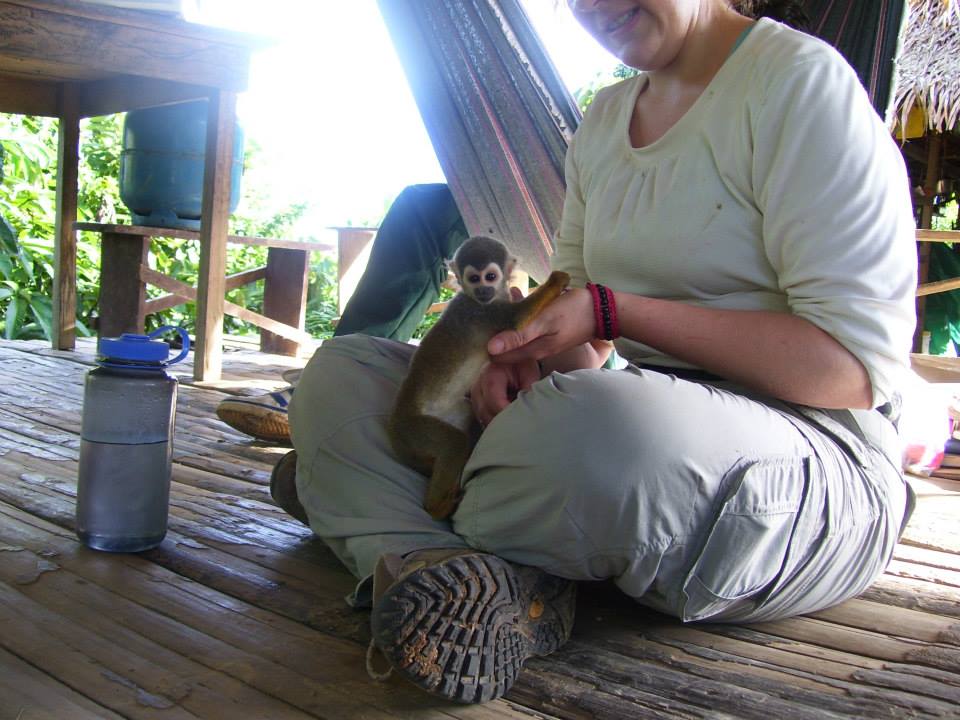

I don’t want to spend my days in a hammock in a parking lot. I want to spend my days connecting with the world around me. In our fast-paced modern society we miss so much that I found so soothing in the jungle. The simple comfort of physical touch or the sheer happiness of a young child’s laughter are all too often misconstrued as annoying or inappropriate on a daily basis. How did I lose those memories so quickly? What can I do to preserve and embody that connection and peace in a life filled with modern demands?

Realistically, I understand at this point in my life it’s impractical for me to give up everything and move into a hut in La Libertad – but that’s exactly what my friend Ben, founder of the Amazon Pueblo non-profit organization, did last year. His full-time presence (divided between the village and the nearby city of Leticia, for logistical reasons) in Colombia has ensured the growth and expansion of Amazon Pueblo in ways we could only dream a few short years ago. His in-person efforts have resulted in bringing safe electricity to the villagers, a safe dock for villagers and visitors which can facilitate more tourism, and therefore more income, and legal recognition in both the US and Colombia of Amazon Pueblo as a non-profit organization dedicated to improving sustainability and quality of life in the village.

Those of us serving on the board of directors here at home support and do what we can, but everyone is always “so busy” these days – it can be difficult to even find the time to write. Showing up and giving of your own time and energy can make such a difference in the world around you. By the same token, how you choose to use your time and energy makes a difference in you. That’s what I need to examine more carefully. Am I making the best use of my time and energy? Am I content with my choices and the results? Am I practicing what I’ve learned and living a life of purpose and peace, or am I falling into the unexamined life of the daily rat race?

I’m the only one who can answer these questions for myself – but it’s worth taking the time to pause and reflect on a regular basis.

(originally posted on my personal blog, www.sarahgoesplaces.com)

Friday, June 19, 2015

Emerald fish scuptulre for sale for the Amazon!

Fish for sale!


I found this fish carving the last time I was in the emerald district in Bogotá. While negotiating the price, I had a hard time pretending that I was not really interested in buying it! I think it is a beautiful sculpture. I have it in my kitchen where I enjoy it every day. It is a good size and weight, not too big or too small. Much fine detail has gone into the carving, and its body seems to be in mid-swim in the water. It is very dynamic in its presentation.

The material is emerald in emerald-bearing matrix. It is from the Muzo mines in Boyaca, Colombia. The eyes are two opaque, cut emerald gems.

I am coming back from Colombia to the USA on June 28. Therefore, I will not be able to ship it until that time.

I am selling this to support my volunteer work with the project.

If interested, please check out my Ebay listing: http://www.ebay.com/itm/Colombian-Emerald-Matrix-Fish-Sculpture-/201374089058?ssPageName=ADME:L:LCA:US:1123

Amazon Pueblo, officially a federally tax-exempt nonprofit!


Great news!
501c3
Amazon Pueblo is now officially a 501(c)(3) federally tax-exempt nonprofit.  My mom received our determination letter in the mail this week, dropped it off to Julie (our secretary), who scanned and emailed it to me in the Amazon.  Thanks mom and Julie!

I expect the designation to do a number of things for us:
1.       People who give donation can now deduct them on their federal tax return.
2.       Certain expenses that we personally spend to complete our mission may also be deductible.  Travel to the Amazon as a director is one thing that would be covered, providing certain condition are met (which, if I remember correctly, are not unreasonable).
3.       We are eligible for discount specialized nonprofit accounting software and other programs.
4.       We are eligible to sign up with other nonprofit organizations which offer free services (like accounting audits, website design, marketing, and management consultation).  I believe that work-at-home volunteers may also be identified to help us with other things.
5.       We are eligible to receive grants from the government, other nonprofits, and foundations.
6.       We are eligible to receive discounts to grant support services and databases.
The only downside is that we need to find the time to access and use all of these benefits.  And if we do get a grant, that will come with another increase in work load. 

Amazonian Government
This week I also received news that our grant to finish the dock and pier was approved.  The government is also interested in working with us in the future, if everything with the dock goes well.  This offers us a big opportunity, not just in the form of extra funds, but in the areas of legitimacy, better access to information, and help with the project’s goals.
I expect to meet with the governor next week to sign the documents which will permit us to work together.  Registering as the Colombian-based Fundación Amazon Pueblo was instrumental in achieving this connection.  I will take and post a picture of the signing when it happens!

Wednesday, June 10, 2015

They see the light in La Libertad!

After almost three months without a post -I AM BACK!  Much has been going on with the project.  We now have an office in Leticia.  Our Internet connection is very poor, the main reason for the lack of posting.  In July I will go back to the USA to fundraise, work, and plan.

One of the most successful infrastructure projects we have had with the project was the effort to bring electricity safely to over 100 people. The villagers mostly use electricity to power one or two compact fluorescent light bulbs, a TV, or a radio (sometimes all these things at once). The hours of electricity are from 3 pm until 9 pm, daily.


The electricity is supplied to the villages by a business named ENAM. They have a contract with the government to supply subsidized electrical power using a large diesel generator. The village has grown to have five main “streets” which radiate outward from the school buildings, which are the largest structures in the village. Four of the streets were connected to the grid properly, by heavy wires connected between 30 foot high wooden or cement poles. The fifth street had been connected to the grid by the villagers, using lightweight wire, old household extension cords, and savaged power cords from broken appliances. These were pieced together, bit-by-bit, as each house found the wire to connect to the adjoining house.

In all, 14 houses representing over 100 people were connected in this fashion. Whenever there was a high-use device (like when a person attempted to connect a clothing iron) the wire would start to burn at is weakest link.

Rain would also cause problems. The water would cause short circuits, knocking out the power. At other times people would receive electrical shocks when touching wet surfaces around the connections.

Sometimes the wires were strung so lowly that people would have to duck when passing. Children would frequently play around theses live, low-hanging wires. The wires were joined by being twisted together and then wrapped with a bit of old plastic bag.

We worked with the village to submit a letter to ENAM. They arrived within 5 weeks to do the work. The village had to provide four 30 foot wooden power poles. For three days before the scheduled installation date we found, cut and carrier the poles to the sites. The Amazon Pueblo project provided the money for the gasoline, oil and refreshments needed to cut the poles.

During the installation one of the workmen from the energy company spoke with a villager. He said, in passing, that if it were not for the foreigner who submitted the request, the company would not have done the work. At last, a small success!


Thursday, March 12, 2015

Amazon Clinic: Healthcare in the Village (life and death)

Andres, the day after hitting a tree limb in the jungle
Andres was playing, running along the side of a jungle pond.  He slipped and a broken tree limb raked up the side of his face, splitting open his cheek and above his eye.  I heard him crying as he was helped, by his many young cousins, back to his house.  I knew it was more serious than the usual falling or upset child event, as even the adults were rushing to see what had happened.  Something about the tone of the crying that alerts them.

Before I could go down to look, Andre's cousin, Stephanie, came running into my house and said Andre's uncle asked if I had some surgical stitches and if I could stitch up his face.  While I did have the stitches for emergencies, I have never applied them to someone.  I did not want my first try to be on a boy's face.

And, after looking more closely at him, he did need stitches.  The wound had split cleanly, and was bleeding freely.  However, due to the tension in his chubby cheeks, the would would not close.  I knew that leaving it open to infection was not a wise choice.  I applied iodine to the wound and advised them to go to a town 30 minutes downriver, by slow boat, where he could receive medical help.

One and a half hours later Andres and his father returned.  The clinic was closed and no one could apply the stitches.  At this time they were starting to become desperate.  He borrowed the suture kit and tried another close village where, it was said, one of the villagers knew how to apply the stitches.  At this time it was nightfall, so a trip to Leticia would be very dangerous on the river.

Three hours after sunset they returned.  Andres was all stitched up.  His picture is from the day after the incident.

This is one example of the healthcare in the village.  The project volunteers have a well-stocked medical kit, which can handle almost anything short of surgery.  Villagers regularly ask for aspirin, antibiotics, or other things.  Mostly I give them advice, bandages, and Tylenol, but never aspirin.  Giving an aspirin to a person who has Dengue fever can complicate the illness.  And Dengue fever is common among the villagers.

One of the most frequent and worst request I receive is for anti-diarrhea pills for babies.  This usually comes after the second of third day of diarrhea.  I do not give the pills, as stopping the diarrhea and keeping the parasitic infection in the baby can be as harmful as the dehydration.  I explain about giving the baby only purified water and food that is not contaminated.  I also have powdered re-hydration mixes that they may try.  My best advice is for them to take the baby to the hospital in Leticia if he or she does not improve.  However, they will only do this at the last moment when it seems eminent that the baby will die.  The trip to Leticia is very expensive for them.

During my last three months of  living in La Libertad three people have died.  One person committed suicide after a fight with his wife.  This incident also involved alcohol.  He left behind his wife and five children.  This was two days before Christmas. The second death involved a 70 year old man.  He had untreated stomach cancer.

The third death was the strangest of the three.  A 30 year old man came down with a weakness on one side of his body.  He continued to loose strength, and weight, over a period of five month.  He received treatment in Bogota, where they found and removed a parasite from his brain.  His health continued to decline, and the doctors could not find the reason.  He was our neighbor, living next to the project's guesthouse.  He died at 1:10 at night, during the middle of a huge thunder and rain storm.  The man left behind a wife and two small children.  One of the children is Andres, the boy mentioned in this story.

Tuesday, March 10, 2015

A new project boat

We have a new boat!  Our boat was hand-made in Peru, of wood.  It is about 21 feet long and has high sides.  While it is slightly tipsy when getting in and out, it is very stable and rides high when loaded and under power.  We modified it by placing side benches and a roof.  The roof keeps off the worst of the rain and sun.  It is painted in oil-based paint to preserve the wood.  A light-weight, rot-resistant wood was used for its construction.  We hope to get at least three years of use from the boat.

The boat will be used for volunteers, tourism, and to transport villagers when needed.  It seats six people, including the pilot, and a reasonable amount of gear.  It is powered by a 13hp motor (owned by our village supporter Gustavo).  While this is still considered a "slow" boat, when loaded lightly in can make the trip to Leticia in under 2 hours.
Our new boat at the Leticia docks
 Below is our old boat.  The worst problem it faced was severe structural rot.  It also rode low in the water, was not covered, and made with a heavier, less rot-resistant wood.

The old boat now belongs to the village kids


Christmas dinner photos!

Now that I am in Bogota I can upload some pictures.

After boiling and cooling, the chicken is shredded
On December 25 of 2014 the Amazon Pueblo project hosted a dinner for the Children of La Libertad.  The meal was a traditional Colombia favorite, arroz con pollo (chicken and rice).  We also served chicken soup and soda.  I bought the supplies in Leticia the day before, then boated them back to La Libertad with Gustavo.  Five village women helped to prepare the dinner.  We had a good turnout, with over 100 kids attending.  We had enough extra food for the parents as well.
Betty is cooking the chicken soup
The kitchen is a popular place to wait for the meal
Chicken broth soup

The main meal, arroz con pollo
A long line, but everyone waited patiently
Enjoying the meal


Monday, March 2, 2015

I have returned! Visit us in the guesthouse!

After a long time without a blog post I have returned once again.  Much has happened with the project, which I hope to be able to pòst in the coming two weeks.


I am currently in Bogota, so the internet connection is fast enough for use.  During this trip I am going to start the process of officially registering the project as an NGO in Colombia, get more information from the Minstery of the Interior of Colombia on how to register the village as an offical legal entity, and fix a problem with my resident Colombian visa.

I have also moved the office of the project to Leticia, where I will live and teach English while managing the project.  The English teaching will, I hope, provide for my living expenses.  But more on this in a future post.

And now, THE GUESTHOUSE!  I have registered the guesthouse with AirBnB, an internet business that helps people to rent their homes.  I have used their service very sucessfully in Maine, USA, and I hope to also have good luck with it in the village.  When we have spare beds, tourist may rent out the bed in hostel-fashion, or the whole house when available.  Below is a link to our listing.  Check it out and come for a visit!

https://www.airbnb.com.co/rooms/5270758?guests=2&s=_s5V 

Thursday, February 12, 2015

A Great Experience in La Libertad

Hi Everyone,

My name is Jeff Sires and I am engineer-in-training from Conway, New Hampshire. I just returned from an incredible trip to the community of La Libertad, where I met with Ben and some of the villagers the Amazon Pueblo Project has been working with. The purpose of my trip was to become acquainted with the community, its people, and to investigate a defunct water filtration system similar to one I worked on for my senior project in civil engineering at the University of New Hampshire. My only regret is that I had just three days to spend in La Libertad.

After completing a project in Peru for Engineers Without Borders, I took a short flight from Lima to the amazon region and Iquitos, Peru. There, I waited one day for the fast boat (barco rapido) that would take me down the Amazon River to the area known as Tres Fronteras -- where Peru, Colombia, and Brazil all come together. The 12 hour boat ride took me through the heart of the Peruvian Amazon to Santa Rosa. After arriving in the late afternoon, I took a short water taxi across the river to the city of Leticia, Colombia where I stayed the night before taking a morning boat to La Libertad.

The barco rapido, which took me from Iquitos, Peru to Santa Rosa, Peru.

The view from Santa Rosa, Peru, looking across the Amazon to Leticia, Colombia.

A view of the village, taken as I was standing next to the guest house facing in the direction of the Amazon River,
Upon arrival to the village, I was met by Ben on the newly finished balsa, or dock, along with a strong rainstorm that made us happy to have shelter for an hour or so. As the rain subsided, Ben and I discussed recently completed projects, future possibilities, and eventually made our way to the guest house where I was impressed to find remarkably comfortable accommodations for such a remote location. I was happy to have my own bunk fitted with bug netting, along with use of kitchen and bathroom behind the house -- both with functioning water systems.

My bed in the guest house.
As the first afternoon went by, I was introduced to some of the neighbors, including Gustavo. Despite relatively basic living conditions and a strong motivation for their improvement, the villagers were very friendly and generally happy. I felt welcomed by everyone, especially Gustavo and his family who live in the house adjacent to the project guest house.

Tired from travel, I fell asleep around 8 PM and woke up early the next morning. I took some time to walk around the site of the water filtration system installed by an NGO several years prior. According to locals, the system had not been functioning for about seven years. It had been designed to use slow sand filtration as means to remove particles and contaminants from the local water source. Many of the components are still in place, but some have been removed and used for other purposes in town. In looking at the system, and with my knowledge of how slow sand filters operate, it appears that the system could be rehabilitated fairly easily. The challenge, though certainly possible, would be to ensure its sustainability through education of local caretakers and the village in general.

Water tanks on a concrete platform, previously used as part of the water filtration system.
For the rest of my time in La Libertad, I helped Ben to work on walkways surrounding the guesthouse, asked as many questions as I could, and practiced my Spanish with Gustavo's son, Hector. In meeting some of the locals, it is clear that there is great motivation for improvement and a wealth of knowledge and commitment to the Amazon Pueblo Project.

Overall, I was very impressed with the work that has been done in the community so far, and excited by the idea of returning to do more myself. Over the next couple of months I hope to apply for funding through grants and other sources to help repair the town's water filter, as well as to send students from the University of New Hampshire (from academic departments such as Engineering, Sustainable Agriculture, Nutrition, Anthropology, etc.) to the village for other potential projects. I will be sure to post updates as these things develop!

I want to thank Ben, the Amazon Pueblo Project, and the community of La Libertad for giving me the opportunity to visit and work with the village. I hope to return soon!


A picture taken from Gustavo's boat on the return trip to Leticia.

Boats arriving at one of the docks in Leticia.

Wednesday, February 11, 2015

Visit and Stay in the Amazon!

Our guesthouse is finished.  Come and visit us in the Amazon!

The current rate of exchange is $2,400 pesos per US dollar (February, 2015).