We received our Charitable Solicitations Act License yesterday! This is needed to legally ask for donations in the State of Maine. Our license covers us for up to $10,000 in donations per year.
The next step is to start planning our first fundraiser. If our publicly supported fundraiser is successful (doing so allows us to meet the federal tax requirements) then we can apply for our federal 501(c)(3) exemption status!
Friday, October 26, 2012
Wednesday, October 10, 2012
The first look at our new kitchen/laundry/shower house!
Please give a big thank you to Gustavo for his work on our new combined kitchen, laundry and shower house!
Food-born illness and sanitation issues plague the inhabitants of La Libertad, but are especially a problem to long-term volunteers who have not adapted to the region. In an effort to provided more hygienic condition for the project's volunteers we are building a combination kitchen/laundry/shower house.
While only the main structure has been completed to this point, we hope to eventually have the following:
Please believe me -after washing cloths in the river using a plank of wood and a small club, washing dishes in water that has been contaminated in toilet runoff, and showering outside by the corner of the guesthouse in the mud -this building will be a very welcome addition.
Thank you to Andres Bernal for the photos.
Food-born illness and sanitation issues plague the inhabitants of La Libertad, but are especially a problem to long-term volunteers who have not adapted to the region. In an effort to provided more hygienic condition for the project's volunteers we are building a combination kitchen/laundry/shower house.
While only the main structure has been completed to this point, we hope to eventually have the following:
- a small two burner propane gas stove
- food prep area
- dish washing station
- shelves and containers to store food
- a laundry area
- a shower area
Please believe me -after washing cloths in the river using a plank of wood and a small club, washing dishes in water that has been contaminated in toilet runoff, and showering outside by the corner of the guesthouse in the mud -this building will be a very welcome addition.
Friday, October 5, 2012
Cortar Cabezas (The Head Cutters of the Amazon)
Image is an artistic recreation.
The project work
I am doing now makes for not-to-exciting blog posts. This work involves mostly studying,
reading documents, filling out forms, planning for the future and corresponding
with email.
To liven up my posts I am
now going to occasionally add stories of things that I have experienced while
living in the village. Today’s post will
be one such story.
One of the subdivisions of the project is Amazon
Business. In this area we help entrepreneurs
in the village to start or grow their small businesses. We help with business planning and give
business loans of between $550 to $1,100 USD.
The aspiring business person must first submit a proposal detailing what
they want to do, the steps they need to take, and a somewhat detailed list of
for what they will be using the loan money.
During one of these planning meetings I first found out about the “cortar
cabezas”!
At 6:30 in the evening a 30 year old, who I am calling Oscar,
wanted to meet with me at Gustavo’s house.
We met on the porch as the sun was setting. He shook my hand and we talked briefly until
Gustavo brought up the reason for Oscar’s visit, which was to request a
business loan. Oscar was soft-spoken,
and as was the custom of many villagers, he avoided most direct eye
contact.
After I explained the program and expectations, with help from
Gustavo, the time came for Oscar to state his business plans and for what he
would need the money. He explained to me
that he wanted to start a fishing business.
He mentioned how he would fish, how many he expected to catch, how he
would store and transport the fish downriver to sell in the city of
Leticia. We proceeded to list, item by
item what he would need. Line, nets,
sinkers, net repair kit, Styrofoam coolers, and the like were noted by him. Towards the end of the list he paused for a
little longer than for the other items. At
this point he mentioned the item “escopeta”.
I recognized this word as meaning shotgun, but I believed my translation
to be bad. Spanish has many words that
have multiple meanings. I question again
and Oscar confirmed that my translation was correct. He had indeed meant he needed a shotgun. I must have looked surprised, because after a
moments silence he went on to explain that he needed the shotgun for the “cortar
cabezas”. Once again I doubted my
Spanish translation skills, for I understood him saying he needed the shotgun
for protection from the head cutters.
Gustavo was intently following our conversation. He then stepped in to explain that when
fishing at night, the time when the fishing is best, fishermen have the risk of
being attack, robbed and killed by the head cutters. After further questioning, during which time
I was being eaten alive by mosquitos and other insects, I learned from them that
the head cutters would wait on the banks of the river from high places, and
then swoop down with paragliders onto a fisherman. While approaching the fisher the head cutters
would shine a special light into their eyes which would blind and make them
dizzy. After this they would kill and
rob the fisherman. It was for this that
the shotgun was needed.
During this explanation I looked for signs that Oscar and
Gustavo were joking. They were not. I politely kept a relaxed expression on my
face, afraid that my slight shock/disbelief might offend them. I tried to rationalize what they were
saying. Why would people who owned paragliders
wait on the banks of the river to rob fishermen? Who were these people? Where did they keep their gliders during the
day? From what high spots did they jump?
Was the light that they used to blind a laser? Was this related to stores of the headhunters
of the past? Was this an “urban legend”
of the jungle? Additionally I knew that
it was illegal to own private firearms in an indigenous village.
What did I do? After
adding up all the cost we found that he didn’t have the money needed to buy the
shotgun. Thank goodness for
budgets. But another question
remains. They say that in every story there
is a grain of truth, and Oscar and Gustavo believed this story. The grain of truth in this story –something I may find next time I
am visiting the jungle…
Wednesday, September 5, 2012
Forms, paperwork, documents, BUREAUCRACY!
Between the time I have been getting ready for work and my college classes, I have been wading deeply through paperwork.
So what has been going on lately?
- Gustavo has started work on the kitchen/shower/laundry house located next to the guest house.
- In a special meeting of the board of directors we have changed the articles of incorporation, adding a provision for the disbursement of assets on the dissolution (hopefully not for many years) of the company.
- Our State license to solicit donations should be awarded by September 15, however it is valid only in Maine.
- We have started the paperwork for our federal tax exempt status, 501(c)(3), which I hope to submit by the end of September. This will allow us to apply for grants, to be able to offer tax exemption to our donors, and to apply for other forms of aid.
- We are looking at online project management solutions. This should help us to share documents and collaborate more efficiently.
- The Maine Women's Business Center at CEI is helping us with the business planning aspects of the project, and giving us overall great advice and contact info.
- We are trying to organize an eco-tourism trip to the Leticia area and La Libertad for six people through my town's adult ed department. We would go in June if it's possible.
- Five people have expressed interested in visiting La Libertad to volunteer this winter and spring, including people with business experience.
- More on these and other exciting news to come!
Sunday, August 26, 2012
Emeralds for Amazon Pueblo!
Do you know anyone who likes rough emeralds?
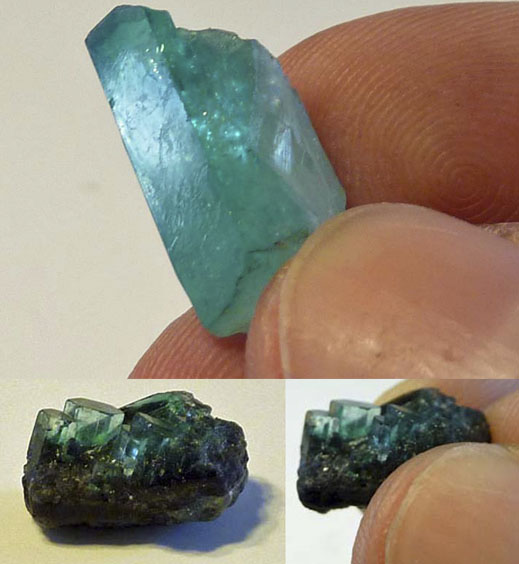
Amazon Pueblo has received a donation of rough emerald crystals for the project. They are being sold on Ebay, and may be visited here. The money from the sale will be used to help support the new small business loan program we are starting, and with transportation and infrastructure support in the village. I will post more about the loan program in the coming week.
Tuesday, July 31, 2012
Amazon Pueblo, Inc. Now a registered nonprofit corporation in Maine, USA!
Friday, July 13, 2012
Ben back from the Jungle! Can´t anything be easy???
I have spent the last week in La Libertad, trying my best with my meager Spanish to have the people of the village understand what the project is and what we are trying to do. It seem like the project may be taking a change. The village does not want clean water and sanitation anywhere near the level at which they want BUSINESS!
What do I mean? When I arrived in the village, as I was walking up the slippery mud trail from the boat landing, I was called to by the elected chief of the village. He had been drinking at a log cutting/carrying party earlier, and was very forceful in telling me that he did not understand who I was or exactly what the project was for. He further went on to tell me that I was not authorized to make private business deals with anyone in the village. He ended with the question of where the village boat was (valued at over 8 thousand dollars) that he had requested from me six months earlier. It is the custom of the villages to have the chief be the main controller of the village boat.
Over the following days I spoke twice at village meetings of over 100 people, showed my computer slide show to other small groups, and met individually or in pairs with still more people to discuss the project. I have also been talking with other people, tour operators in the nearby city of Leticia, who have helped fill in parts of the picture. It seems like most of the people have access to much water which they consider clean (which is NOT, and has been tested by me), and find it bothersome and difficult to dispose of their human fecal waste in ways other that going to the bathroom on the ground within 40 feet of their homes. They also seem to not value good health as much, instead living with and adjusting to intestinal parasites and other ailments.
What did come up in all of the discussion was the will of the people to find work. This was the most desirable part of the project by far. It was followed (as a slightly distant second) by the desire for the villagers to have their children speak English, which was also directly related to the opportunities the villagers believed this would afford their children and families. And how did they expect the project to provide this work? By small business loans!
The amounts that they are requesting are usually between 500 and 1,000 dollars. Their plans sound good and workable. Who is funded might be decided upon by a council of villagers. And given that all are well-known in a community of 400, the hard workers and ideas that have the most chance of succeeding could be funded. The money could be lent at a one-time interest rate of 5%, to be payed by monthly payments at a 12 or 24 month schedule. Simple business plans may be drawn up with the borrowers and loan notes signed and notarized in the city. When (hopefully) the loans are repaid the money may be reinvested in other businesses.
And how does community improvement and environmental sustainability fit in? This could be the project´s way to get our foot firmly within the door. We can also require that the people who profit form the project´s loan give a percentage of their profits back to the community for development projects, including clean water and sanitation.
Well that´s it for now. I am very tired, had a touch of severe intestinal discomfort earlier, and I must start running around early tomorrow morning to get a resupply of food and the materials I need to mount and connect the solar panel. Hopefully my next communication will be from my laptop within the jungle!
What do I mean? When I arrived in the village, as I was walking up the slippery mud trail from the boat landing, I was called to by the elected chief of the village. He had been drinking at a log cutting/carrying party earlier, and was very forceful in telling me that he did not understand who I was or exactly what the project was for. He further went on to tell me that I was not authorized to make private business deals with anyone in the village. He ended with the question of where the village boat was (valued at over 8 thousand dollars) that he had requested from me six months earlier. It is the custom of the villages to have the chief be the main controller of the village boat.
Over the following days I spoke twice at village meetings of over 100 people, showed my computer slide show to other small groups, and met individually or in pairs with still more people to discuss the project. I have also been talking with other people, tour operators in the nearby city of Leticia, who have helped fill in parts of the picture. It seems like most of the people have access to much water which they consider clean (which is NOT, and has been tested by me), and find it bothersome and difficult to dispose of their human fecal waste in ways other that going to the bathroom on the ground within 40 feet of their homes. They also seem to not value good health as much, instead living with and adjusting to intestinal parasites and other ailments.
What did come up in all of the discussion was the will of the people to find work. This was the most desirable part of the project by far. It was followed (as a slightly distant second) by the desire for the villagers to have their children speak English, which was also directly related to the opportunities the villagers believed this would afford their children and families. And how did they expect the project to provide this work? By small business loans!
The amounts that they are requesting are usually between 500 and 1,000 dollars. Their plans sound good and workable. Who is funded might be decided upon by a council of villagers. And given that all are well-known in a community of 400, the hard workers and ideas that have the most chance of succeeding could be funded. The money could be lent at a one-time interest rate of 5%, to be payed by monthly payments at a 12 or 24 month schedule. Simple business plans may be drawn up with the borrowers and loan notes signed and notarized in the city. When (hopefully) the loans are repaid the money may be reinvested in other businesses.
And how does community improvement and environmental sustainability fit in? This could be the project´s way to get our foot firmly within the door. We can also require that the people who profit form the project´s loan give a percentage of their profits back to the community for development projects, including clean water and sanitation.
Well that´s it for now. I am very tired, had a touch of severe intestinal discomfort earlier, and I must start running around early tomorrow morning to get a resupply of food and the materials I need to mount and connect the solar panel. Hopefully my next communication will be from my laptop within the jungle!
Saturday, July 7, 2012
In Leticia today!
This week I have been very busy in Bogota trying to get ready for my visit to La Libertad. I have succeeded in doing almost all of what I wanted. Highlights include buying 2 LifeStraw Family filters, each capable of filtering 18,000 liters of water for up to three years of use. What is especially great about these is that they are gravity fed, filter bacteria AND viruses.
I have also managed to connect my laptop to a USB modem and to connect this to the cell phone data network in Leticia. In fact this post is being made over that connection. It is surprisingly fast, but I do have 5 out of 5 bars for a signal. Tomorrow I will be able to test the connection in La Libertad. However I do not expect much, as at times I am lucky to have 1 bar of signal strength. Later in the week I hope to have a cell phone and data signal amplifier set up in the village.
Leticia is surprisingly cool for a change. It was only in the 80's today. While here I had a chance to speak with Felipe, the owner of a major tour company here in Leticia. He had many good insights about the project which helped clarify the direction I am going to take. One thigh he mentioned was the lack of care that most of the villagers had for improving their condition, including sanitation and water quality. He also mentioned the jealousy that other villagers may have for Gustavo, one of the main proponents of the project in La Libertad. These are just two of the areas I must explore further.
Tomorrow we will go shopping and pick up supplies for the week. If things go well we will be back next weekend to pick up more supplies and equipment. If things do not go well in the village we may go back to Bogota instead. Keep your fingers crossed!
Subscribe to:
Posts (Atom)